Best Practice In The Improv Classroom
04/April/2025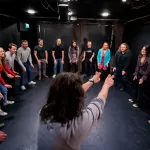
There’s No Such Thing As Community In Improv?
03/October/2025
Participants at one of my workshops
The USA is no longer the land of the free. So when I was preparing to go teach at Improv Utopia East in New York this year, I was quite apprehensive about setting foot in a country that used to excite me to go to. I was last in the US in March 2020 (remember what happened then?), so it has been some time.
However, Improv Utopia (IU) has always been my happy place. This time it’s juxtaposed with a political and social environment in the US that is akin to the Middle Ages, so the joy was at risk of being contrasted by menace.
American people have changed. Once the bastions of positivity, encouragement and everything being awesome, I was now having deeper conversations with people who are angry, scared and touting a cynical outlook often reserved for Irish people when topics like the housing crisis and the HSE arise. This made the Improv Utopia East experience hit different this time round, and in more ways than one. But overall, the love for community and improv amongst campers made the experience extremely positive.
Hello again
2014 was my first ever Improv Utopia experience, also an East camp. (From a European perspective camp is the American way of saying retreat, and camp councillors are cabin leaders rather than therapists! East refers to eastern USA). It was both an overwhelming yet incredibly enriching experience. It became an annual staple in my calendar until COVID hit. I’d taught at IU international camps before, but this was the first time I would be teaching at one of the US retreats. This year, the East retreat took place in Camp Kennybrook in the wilds of New York State.
That presented a challenge for me in a number of ways. The standards of teaching and Improv Utopia are very high, with heavy hitters both teaching and participating. The desire to offer something new that US improvisers may not have experienced before was important to me and meant having to design an offering from the ground up. In the end I opted to teach relationship based 2 person scenes grounded and led by emotion with sprinklings of trying to understand what an audience wants versus what an improviser thinks an audience wants. (The offering was called Go Through That Door!)
Add to this that the workshop participants also included friends and campers I have known since 2014. It’s one thing disappointing strangers, it’s another disappointing friends! That being said, anecdotally the feedback was very positive and humbling. So much so that it gave me a new lease of life with teaching and understanding different students’ perspectives and fears on stage.
How do you know you are not a barrier to inclusivity?
When I was undertaking a Masters in Training years ago, my research supervisor Peter Gilis asked this question a lot of us. The vast majority of teachers and theatres will say they are inclusive etc, but the taste test is in the dynamic of the classroom and the stage. Having LGB (note the absence of the T) students and performers is not a benchmark for inclusion.
I am a strong believer that creating a safe, inclusive environment that practices pro-actively what it preaches makes for better improv all round. The diversity of voices and experience, the removal of competitiveness, creates an environment where people can lean in their authenticity more, feel supported and reach conditions that allow for our best work. This is in addition to the wider and obvious reasons as to why diversity is so important.
Improv Utopia should be the benchmark for diversity and inclusion in the arts as well as creating a safe space for everyone. The team go to great lengths to achieve that and the pay off is in the feedback from participants. As Europeans, we can learn a lot from the experience but need to start now.

Campers holding a Paddy’s Point flag for no reason.
The Elephant in the Room
My road trip buddy this year was friend and improv maestro, Ferran Luengo. An outspoken Spaniard living in London, he has created some essential reading recently about the conflict in the Middle East and the mostly silent response from the improv community which contrasts that outpouring of support we see for Ukraine. As Europeans, and particularly as Irish and Spanish people, our views on the conflict do not align with the government in the US. This was something we were concerned with about travelling there.
For the most part, when it came up among campers, the conversations were mostly aligned. There was common ground in the desire of wanting the conflict to stop and acknowledgement of the horrors that have emerged. But even more so than Europe, it feels like to speak out about it is taboo in the US. (Although one camper was wearing a keffiyeh on occasion.) Taking this home, it is clear to me that we have to do more to raise awareness of our disgust at the horrors in the Middle East. While many of us will claim our improv communities and theatres are not political, by not allowing discussion and the voicing of grave concern, we are being political.
Jet Lag
In closing and with a jet lagged head, I am extremely grateful to Nick, Jacque, Tashika, Jessica and the IU team for the opportunities IU has given me as well as taking a punt on me teaching in the US this year. In particular this year, it was only when I got there did I realise how much I needed an IU experience this year. As someone who makes a living from improv, my relationship at times with improv in Ireland and Europe feels strained. IU allows me to blend work with pleasure in a very healthy way, and it has refilled my heart.
For more about Improv Utopia, check it out here.